Buying Guides
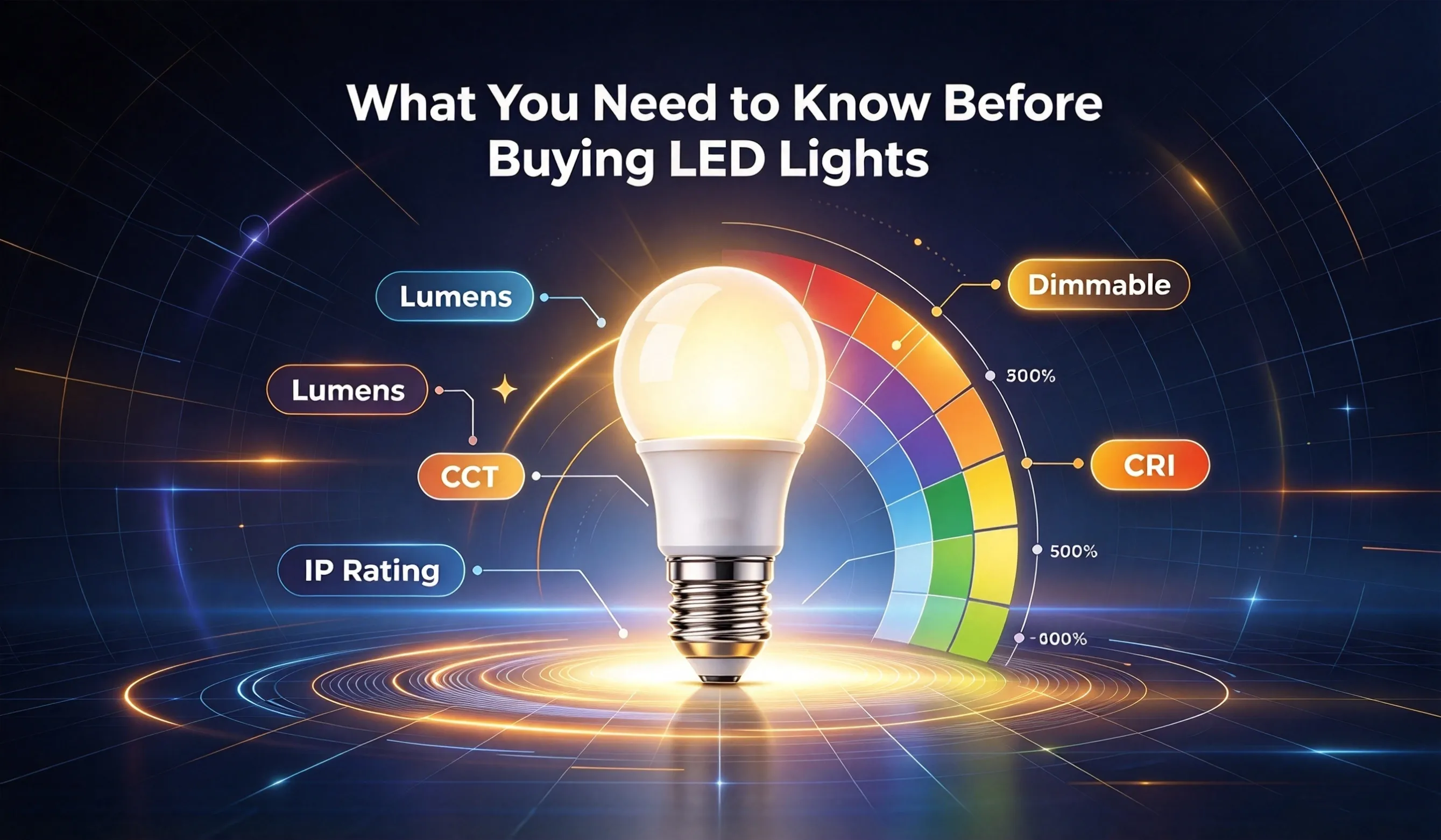
What You Need to Know Before Buying LED Lights
Essential tips and factors to evaluate before buying LED lights, to help you pick reliable LED lighting products.
Q1: Operating Voltage: Wide Voltage 100–240V vs Fixed Voltage LED Lights
A1: Wide-voltage (100–240V) products are ideal for global trade, allowing the same item to be sold in markets like Europe and North America, whereas fixed-voltage products are limited to specific, single markets. In regions with unstable voltage, wide-voltage drivers offer superior resistance to power fluctuations.
Homelamplify Advantage: Most of our downlights, spotlights, and wall lights utilize AC85~265V wide-voltage drivers, making them compatible with markets across various countries. Our table lamps—classified as portable lighting—typically operate on low-voltage (5V or 36V) systems.
Q2: Is Higher Lumen Always Brighter?
A2: Lumens represent the **total luminous flux**—the overall amount of light emitted by a fixture. However, perceived brightness is also influenced by factors such as beam angle, anti-glare design, and the fixture's reflective structure. For instance, given the same lumen output, a spotlight will produce a concentrated beam that appears more intense at the center, whereas a downlight provides a broader, softer wash of light; each case must be evaluated individually.
Homelamplify Advantage: We provide verified lumen specifications for our downlights, spotlights, wall lights, and table lamps—no exaggerations. We can match the appropriate lumen output to your specific requirements and offer professional lighting design solutions for commercial and engineering projects.
Q3: Color Temperature 2700K / 3000K / 4000K / 5000K / 6000K: How to Choose for CCT for different lamps?
A3: 2700K – Warm Yellow (creates a cozy atmosphere; ideal for hotel guest rooms and bedroom wall lights); 3000K – Warm White (suitable for residential interiors and homestays); 4000K – Neutral White (perfect for offices, hallways, and commercial corridors); 5000K–6000K – Cool White (best for supermarkets, workshops, and reading lamps).
Homelamplify Advantage: We offer both fixed color temperature and tri-color adjustable options. For any given project, we ensure a consistent color temperature bin to minimize color variation. Customization is available across our entire range, including indoor wall lights, downlights, spotlights, and table lamps.
Q4: How to Read IP Rating for LED Wall Lights — IP20, IP44, IP54, IP65 Explained
A4: The first digit is dustproof, the second digit is waterproof. IP20 = indoor dry area; IP44 = semi-outdoor, under eaves; IP65 = open-air outdoor wall light, protected from rain. Reminder: IP rating ≠ never condensation, temperature difference condensation is another problem.
Homelamplify Advantage: Indoor wall lights IP20, semi-outdoor IP44, outdoor wall lights IP65 split line development, can recommend suitable IP according to the customer's local climate.
Q5. Beam Angle Explained: 15°,24°,36°,60° — Spotlight & Downlight Angle Selection Guide
A5: Narrow beam angles (15°–24°): Ideal for highlighting exhibits or decorative artwork. A 36° angle offers a balanced effect, while 60° and wider angles provide flood lighting, suitable for corridors or general ambient illumination. For a given wattage, a narrower beam angle results in higher central illuminance.
Homelamplify Advantage: Our spotlights feature customizable beam angles via specialized lenses. We also offer diverse optical configurations for wall-washers and downlights, and provide detailed beam-pattern diagrams for project-based clients.
Q6: Dimmable LED Lights: What Does “Dimmable” Really Mean?
A6: The term "dimmable" simply indicates that a light supports dimming; however, there are different standards, such as Triac, 0-10V, and DALI. Using an incompatible dimmer can lead to issues like flickering, audible buzzing, or an inability to dim the light to a very low level. Standard, non-dimmable LED drivers cannot be connected directly to a dimmer switch. Please note: the "dimming" feature found in low-voltage desk lamps—which typically involves touch controls or buttons to adjust color temperature and brightness—is fundamentally different from the dimming systems used in commercial lighting.
Homelamplify Advantage: For dimmable versions of downlights, spotlights, and wall lights, the driver type is clearly specified; samples can also be provided in advance for testing with the client’s own dimmers.
Q7: LED Wattage vs Brightness: Is Higher Power Equals Brighter Light?
A7: Wattage (W) indicates power consumption, not brightness. With traditional incandescent bulbs, wattage roughly correlates to brightness; however, LED products vary significantly in luminous efficacy—a high-quality 10W LED can be brighter than a low-quality 15W one. Focus instead on lumens and luminous efficacy (lm/W).
Homelamplify Advantage: We offer high-efficacy options that are energy-efficient and compliant with European ErP energy efficiency standards. For our downlights, spotlights, and desk lamps, we provide transparent specifications, including data on luminous efficacy.
Q8: Light Decay (Lumen Maintenance): Why LED Lights Get Dimmer Over Time?
A8: It is not that the light is broken; rather, it is experiencing "lumen depreciation" (light decay). The root causes are excessive chip temperature, poor heat dissipation, and an unstable LED driver. The industry standard, L70, defines the point at which a light source retains 70% of its initial brightness after 50,000 hours of operation. In contrast, low-cost products often become noticeably dimmer within just 1–2 years.
Homelamplify Advantage: Our downlights, spotlights, and wall lights feature optimized thermal management structures and undergo rigorous factory aging tests. This ensures that lumen depreciation remains well-controlled; for project-based orders, we can provide L70 performance specifications.
Q9: What is CRI? Why Does It Matter for LED Lighting?
A9: CRI (Color Rendering Index) describes how accurately a light source reproduces the true color of objects. Ra80 is the basic standard for general lighting, while Ra90 and above are required for high-demand scenarios such as retail displays, hotel decoration and reading lighting. Low CRI lights will distort the appearance of fabrics, artwork and skin tones. CRI is not the same as color temperature; two lights with identical color temperature can have very different color rendering performance.
Homelamplify Advantage: We offer high CRI options for spotlights, table lamps and decorative wall lights. We can keep consistent color binning for bulk orders to ensure uniform color performance across the whole project.
Q10 Single Color vs CCT Tunable vs RGB CCT: Which LED Light Do You Need?
A10: Single-color, fixed-color-temperature lighting is cost-effective and stable; three-tone (CCT-adjustable) lighting is well-suited for residential retail; while RGB+CCT lighting is ideal for ambient decorative outdoor wall lights.
Homelamplify Advantage: Offers three distinct options, with recommendations tailored to your specific needs.